Frequently asked questions about our fees consultation
Registration fees and rise options
We’re proposing to raise fees by either £50 per year (£0.96 per week), £75 per year (£1.44 per week) or £100 per year (£1.92 per week).
We currently have a reduced registration fee for new graduates until year 3 of practice. For non-practising osteopaths, who do no clinical practice (hands on practice with patients) for three months continuously within their registration year, there is also a reduced fee. We are consulting on whether the fee increase should apply to all categories equally or whether there should be a larger increase for those osteopaths paying the full fee meaning a smaller increase for new graduates and non-practising osteopaths (see questions 7-9 of the consultation). Further below we explain why we cannot introduce more categories, such as for those working part time.
No. Our legislation is prescriptive and we are not able to make small changes each year to the annual fee such as increasing with inflation.
Any changes we make to our fees requires an amendment to our legislation (called Fee Rules) through a formal government process, and there is limited amount of government time available to support major legislative changes (and increasing with inflation would be a major change).
Following this consultation, even though we will only be changing the amounts (which is all that we can do), this will take time to be reflected in the fees legislation. The changes to registration fee levels will likely not come into effect until May 2027.
We’re only able to change the amounts of the fees (the numbers) in the legislation rather than the wording which means we can’t make more substantive changes. This is due to the limited amount of government time available to support the legislative change. We are prohibited from introducing new categories of fees such as for people who work part time, and so these sorts of options have not been considered by our Council.
Our legislation is very restrictive which means we also can’t bring in new categories of fees (stratify the fee), for example we can’t make changes so that an osteopath is charged according to how busy their practice is. We may have more flexibility in the future (in the 2030s) depending on the changes made by government as part of legislative reform.
We are spending more than our income to deliver our statutory duties, which means our financial position is unsustainable going forward. Between 2023-26, our expenditure has been greater than our income by +£540k.
Every year our Council members, in their role as Trustees and with responsibility to ensure the GOsC is financially sustainable, have considered fee rises. Previously they have chosen not to seek fee increases because of the impact on osteopaths, while recognising that this means the GOsC has been receiving less income on an annual basis. We have now reached the point where Council are unable to avoid an increase in fees to ensure our financial sustainability.
Our Financial and Asset Framework, available on our website, explains how else we planned to reduce our spend and increase income, which include:
- The sale of the headquarter building which will remove maintenance and other associated costs.
- Alternative employment/staffing requirements as a result of a different operating model after the sale of the headquarter building, mostly around facilities/estates and the introduction of the new CRM (records management) system.
- Increased income made as a result of investing the money from the sale of headquarter building.
These are in addition to actions we’ve taken to reduce how much we are spending to regulate and develop the profession. Our forecasts show that if we deliver all these actions during our financial year for 2026-27, our spend would be less than our income for the following two financial years (2027-29) before the GOsC moved back into deficit (where our costs exceed our income). You can find out more on in our consultation document.
Sale of the headquarter building
In 2023 we looked into renting out some or all of the building, but an independent report found that we would need to invest more money to make the building secure enough to rent out partly, and if renting out the whole space, it would take many years for us to make enough money from the sale to help us be more financially secure. This led Council to decide to place the headquarter building up for sale.
The GOsC sold the headquarter building for £3.3 million. We recently published a news story to our website about the final sale of the building. This sum will appear in our public November 2026 Council papers (the public financial reports), and in our Annual Report and Accounts for 2026-27 which will be considered at our Council meeting in July 2027. We are required to publish and lay our Annual Report and Accounts before Parliament each year (usually in September), as set out in the Osteopaths Act 1993.
The capital from the sale of the headquarter building has not been spent. Most but not all of the money from the sale has now been put in our reserves, which is the money we keep to help make sure the GOsC is financially sustainable.
The draft Annual Report and Accounts for 2025/26 (available from page 35 of our public July 2026 Council papers and due to be published formally in September) shows that, at the end of the financial year (March 2026) the GOsC’s unrestricted free reserves were £174,000. The remaining reserves of £2,160,719 were known as the operational fixed asset, which reflected the accounting value of our assets, ie the headquarter building.
At its meeting in July 2026, Council also reviewed its designated reserves policy, available from page 73 of the July 2026 Council papers.
The General Osteopathic Council is also a charity and is therefore required to hold ‘sufficient reserves’. While there is no prescribed ‘correct’ level, our Council members who act as our ‘Trustees’ must make sure we have enough money to:
- Support the long-term sustainability of the organisation
- Make sure we can continue to deliver our duties as statutory regulator
- Be resilient against unforeseen risks or changes in income
Council decided that our reserves should be in the range of 8 to 9 months of running costs which is around £2,250,000. This means that we will be holding excess reserves. Charity Commission guidance says that where excess reserves are held, there should be a plan for using these for the beneficiaries of the charity. In our case the beneficiaries are patients and osteopaths. So we need to use this money to regulate and develop the profession for public protection. We’ll be working with Council to consider how we do this, in line with our statutory duties.
By law, we can only use our money to meet our statutory duties, which are to regulate and develop the profession for public protection. There are strict criteria around donating charity funds to another organisation. This means it would not be appropriate for GOsC as a health professional statutory regulator, to donate money to another organisation.
Instead, we want to invest in supporting high quality osteopathic care for osteopaths and patients. Council will begin considering this in November 2026.
No. We have hired a small number of desks in a shared workspace location. This location is owned by a charity who only rents space to other charities, health organisations and those with a social justice purpose. This means we are sharing space with organisations aligned with our values.
We are also planning to work more regionally as an organisation, with plans in place for Council meetings to be held twice a year in locations outside of London, meaning Council members will be able to interact more easily with local osteopaths. We will publicise more information later in the year.
Our finances
Our Strategic Plan towards 2030 is available on our website. The Strategy focuses on how we can work towards delivering our statutory objectives by being an inclusive and innovative regulator, trusted by all.
Our fees consultation document includes information about our financial strategy (pages 31-33). You can also access our Financial and Asset Framework on our website. The Framework explains that our income must match our spend, and that our income must be enough to deliver our statutory objectives.
In our consultation document we explain that our Financial and Asset Framework identifies actions that the GOsC planned to take to reduce expenditure and increase income, which include:
- The sale of the headquarter building which has removed maintenance and other associated costs.
- Alternative employment/staffing requirements as a result of a different operating model after the sale of the headquarter building, mostly around facilities/estates and the introduction of the new CRM (records management) system.
- Increased income made as a result of investing the money from the sale of the headquarter building.
These are in addition to actions we’ve taken to reduce how much we are spending to regulate and develop the profession. Our forecasts show that if we deliver all these actions during our financial year for 2026-27, our spend would be less than our income for the following two financial years (2027-29) before the GOsC moved back into deficit (where our costs exceed our income). You can find out more on page 31 of the consultation document.
Therefore, while Council will continue to explore measures for reducing how much we spend to deliver regulation (explained in detail further below), Council has concluded that the GOsC also needs more income to be financially sustainable through to the 2030s.
One of the main reasons our costs have increased is the significant growth in fitness to practise activity, something which is not unique to our profession and is being seen across healthcare regulation as a whole. Compared with 2018, our fitness to practise caseload has increased by 74%, with a significant proportion of cases relating to professional boundaries concerns. These cases are often complex and lengthy and require greater investment in investigations, hearings and case management. This is not unique to our profession and is being seen across healthcare regulation as a whole.
However, even if we had a smaller fitness to practise caseload this would not mean we’d have immediate cost savings, because our spend on regulating and developing the profession overall would still be more than our income. See page 18 of the fees consultation document for more information.
You can find further details of our fitness to practise caseload in our Council meeting papers, available on our website. You can also find more information about the change in caseload on our key statistics page.
In order to reduce how much we are spending, the GOsC has:
- Brought the work we do to check and assure the quality of osteopathic education in house, hiring our own staff to carry this work out instead of hiring an external company. This is saving over £250,000 over a five-year period.
- Carried out fitness to practise investigations internally, saving around £140,000 per year.
- Reviewed the research journals, which support high-quality osteopathic care, and which we provide for free to osteopaths and penultimate and final year students by asking the profession which titles they use the most, so we could remove the ones not being used. This allowed us to make a year-on-year saving of around £14,000 while still providing the profession with the most popular and useful research journals.
- Restructured the roles of some of our current staff members to focus on our work on patient involvement and the patient voice. This is estimated to save around £18,000 a year.
- Reduced the amount we spend on external research projects, with the 2026-27 budget being £8,000 lower than the previous year.
- Strengthened our in-house research and data analysis activities, meaning that we carry out much of the survey and research work ourselves rather than externally. This is estimated to save c.£10k to c.£20k per year.
- Put in place a new CRM (records management system) to make our registration process more efficient and fit for the future.
- We have renegotiated our software licences and IT security contracts, which is bringing in a saving of over £6,000 in the past year.
These measures are in addition to the decision to sell the headquarter building. This is all set out in our consultation document (see page 12), which also explains that while our Council will continue to explore measures for reducing our spend, Council has concluded that the GOsC also needs to generate additional income by raising fees.
Yes. See p31 of our fees consultation document. Also see: Where has the money from the sale of the headquarter building gone? Why is the GOsC raising fees as well?
Fitness to practise
See above.
Yes, the timelines for our fitness to practise investigations are shorter than those of other regulators. The PSA said, in our 2025-26 Performance Report says:
Based on the available evidence we have seen in this review period, we consider that the GOsC continues to deal with cases as quickly as is consistent with a fair resolution and to prioritise public protection.
The GOsC is not currently using AI in fitness to practise cases because the consequences of AI errors in a fitness to practise case are significant, and there have been severe issues with the use of AI in legal cases in other sectors. We believe osteopaths and patients would be concerned if AI was being used in decision-making within fitness to practise.
However, as a regulator we do have a policy for the acceptable use of AI for our staff team which encourages innovation and using AI to inform our work, being clear that all AI-generated content is reviewed by a human to ensure accuracy, quality and accountability. Read our policy.
We expect that our roll out of AI over the course of the year across other areas of our work will help us to be more efficient in the way we work, as part of Council’s exploration of ways to reduce our spend. However, we are not relying on AI as a guaranteed cost saver.
Our annual report for 25/26 shows that our costs for public protection, which includes managing concerns through our fitness to practise processes are £302 in every £570 registration fee. Our Annual Report also shows that 33% of the fee was spent on fitness to practise specifically, including legal costs:
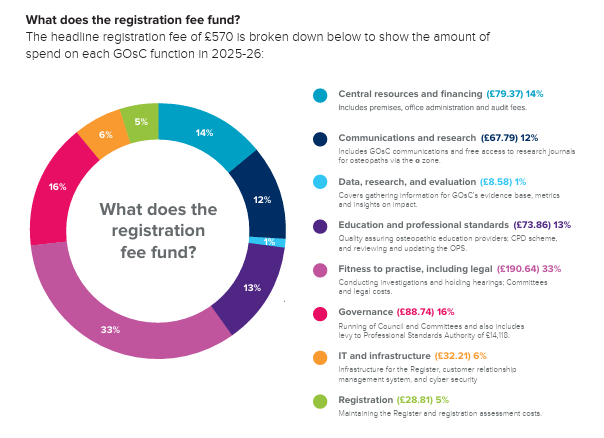
We publish our budgets each year in our February Council papers which are available on our website (see page 65 onwards). The agreed fitness to practise budget for 2026/27 is £565,045 excluding staff costs. This includes legal costs as well as the costs for members of the independent Investigating Committee and Professional Conduct Committee, meaning their time, accommodation and travel costs, and additional costs for holiday pay and pension. It includes the costs of protecting the osteopathic title by issuing cease and desist letters or prosecution.
Our role and governance
The General Osteopathic Council (GOsC) was established by the Osteopaths Act 1993 to ‘develop and regulate the profession of osteopathy’.
The overarching objective of the GOsC is the protection of the public, which means we are responsible for:
- protecting, promoting and maintaining the health, safety and wellbeing of the public
- promoting and maintaining public confidence in the profession of osteopathy
- promoting and maintaining proper professional standards and conduct for members of that profession
Our work includes:
- setting and maintaining standards of osteopathic practice and conduct
- maintaining a Register of qualified professionals
- checking and assuring the quality of osteopathic education and training
- helping patients with concerns about osteopaths
- removing from the Register anyone who is unfit to practise
The table below explains how everything that the GOsC does helps us to either regulate or develop the profession:
| Activity | Regulation | Development |
| Education | Ensuring that all ‘recognised qualifications’ are only awarded to graduates meeting the Osteopathic Practice Standards (OPS). | Promoting high standards of education. Education thematic reviews (eg professional boundaries, recording patient consent) Work with COEI to support strategic development, association of educators, presentations to students on the OPS and professionalism. |
| Standards (Including professional standards of competence and ethics, patient partnership and working with other health professionals) | Publishing the Osteopathic Practice Standards (OPS). Additional guidance eg signposting Covid 19 guidance from UKSA and relevant bodies. | Providing ethical guidance and individual support to help osteopaths to exercise their professional judgement and make decisions. Provision of additional guidance and support, for example, adjunctive therapies guidance. Ongoing implementation of OPS through engagement with osteopaths and educators, ongoing provision of resources (case studies, blogs, videos), development and implementation of values materials. Seminars to support the implementation of our standards and to support CPD (using scenarios) with osteopaths at local level. |
| Registration | Maintaining the Register. Developing mutual agreements between other countries to help ensure we maintain standards and facilitate movement between jurisdictions. | Supporting international applicants to understand requirements for registration and support them to complete forms and demonstrate requirements. |
| Continuing professional development | Minimum requirements to complete the CPD cycle. | Developmental objectives for the scheme (engagement, support, community), supportive engagement (webinars, case studies, animations, videos, completed examples, explanations, 1 to 1 support and advice). Patient engagement work with osteopaths and osteopathic education, promoting interprofessional working. Professional boundaries project and implementation. See our series of boundaries case scenarios. |
| Fitness to practise | Ensuring that those who do not meet standards have their registration restricted or removed. | Support to osteopaths to demystify the fitness to practise process Support for osteopaths who may be vulnerable or need extra support eg funding the Independent Support Service. |
| Research and development | No minimum requirements. | Funding of IJOM and associated journals. Funding towards the National Council for Osteopathic Research. |
The GOsC is overseen by the Professional Standards Authority (PSA), which also oversees the other nine health professional regulators. The PSA assesses the performance of the GOsC against its standards and reports on it annually. You can access information about the PSA on its website. We have achieved a consistent high-performance against the PSA Standards of Good Regulation.
The Privy Council also has oversight of the GOsC in relation to specific functions, for example, the approval of how much we charge for registration fees, of the appointments for osteopaths and lay people (non-osteopaths) to the Council. If the GOsC is failing to exercise its functions properly, the Privy Council also has powers to intervene to exercise those functions. See s34 of the Osteopaths Act for further information.
We are committed to transparency, and most of our major decisions are discussed at our public Council and Committee meetings and informed by papers that are published to our website. You can find our Council papers and our Policy and Education Committee papers on our website. You’re also welcome to attend and observe our Council meetings either in person or online, you can email council@osteopathy.org.uk to arrange to attend.
Our Governance Handbook published on our website sets out the limited circumstances when GOsC will discuss something in private:
- Any personal matter relating to a present or former osteopath or applicant for registration
- Any personal matter relating to an employee or member, or a former employee or member
- Any matter which is commercially sensitive
- Any matter relating to employment negotiations or consultations between the GOsC and staff
- Any matter relating to future policy or strategy where, in the opinion of the Chair, public discussion would be premature
- Any matter which is subject to legal professional privilege
- Any matter that relates to preventing or identifying a crime or the prosecution of offenders
- Identity of the source of any information given to the GOsC in confidence
- Any other matter deemed to be confidential by the Chief Executive which is justified as having equivalent characteristics to one or more of the above.
The future of the profession
Numbers of osteopaths on the Register are still increasing and are currently in the region of 5,600.
However, it is true to say that numbers of osteopathic students are decreasing and this is a concern for the profession. We are working collaboratively with the professional membership body the Institute of Osteopathy and the Council for Osteopathic Educational Institutions on ways to sustain osteopathic education. We explain more in a blog on our website, which outlines for example the apprenticeship standard for osteopathy, which the Institute of Osteopathy worked with employers to develop, and which enables students to access osteopathic education without the burden of fees while still being required to meet the same Graduate Outcomes as students who take the traditional route.
The Institute of Osteopathy is also doing a lot of outreach work to support and raise awareness of osteopathy as a career, as well as work to promote osteopathy to the public.
It is a challenging time, but we believe that working collaboratively with all our partners, using our distinctive roles and expertise to support osteopathic education while also embracing innovation will support the profession in the longer term.
The Institute of Osteopathy is the professional membership body. The General Osteopathic Council is the regulator.
As the regulator, GOsC’s role is to regulate and develop the profession. We work to protect the health, safety and wellbeing of the public, and the reputation of the osteopathic profession. We are responsible for making sure the public continues to have confidence in the profession, and we are responsible for setting the standards for osteopathic education and training that osteopaths must follow to practise safely. By law, osteopaths must be registered with the GOsC to practise in the UK. This provides confidence to patients that osteopaths are qualified, regulated healthcare practitioners, working to high standards of practice and conduct. Find out more about our statutory role to regulate and develop the profession.
Legally, we cannot promote osteopathy to the public or other healthcare professionals. We are only allowed to do what is specifically set out in the Osteopaths Act. Promotion was removed from the Act in 2008 and is now carried out by a membership body, so within osteopathy this is the Institute of Osteopathy.
We also cannot lobby the government on behalf of the osteopathic profession. Lobbying for the profession is a role carried out by a membership body. Find out more about what we do and don’t do.
As a membership body, the iO represents and supports osteopaths rather than regulating osteopaths and the profession. Membership is voluntary and the iO promotes the profession of osteopathy.