Our EDIB performance 2024-26
This report explains how we have made progress to deliver the aims of our Equity, Diversity, Inclusion and Belonging (EDIB) framework 2024-26. This report covers the work we did between 1 June 2024 and 30 June 2026.
We are committed to fostering a culture of equity, diversity, inclusion and belonging across the osteopathic sector and within our own organisation.
Our statutory purpose is protection of the public. We recognise this is best achieved when fairness, respect and equity are embedded in everything we do.
We aim to ensure that everyone we interact with feels valued, heard and able to participate fully. We will work to identify and remove barriers that limit opportunity or undermine trust, and we will use evidence and insight to guide our actions.
As a regulator, we will promote inclusive professional standards, encourage reflective and culturally competent practice, and ensure that our processes are transparent, accessible and free from bias and discrimination.
As an employer and collaborator, we will nurture an environment where diverse perspectives are welcomed and where people feel safe to contribute and thrive.
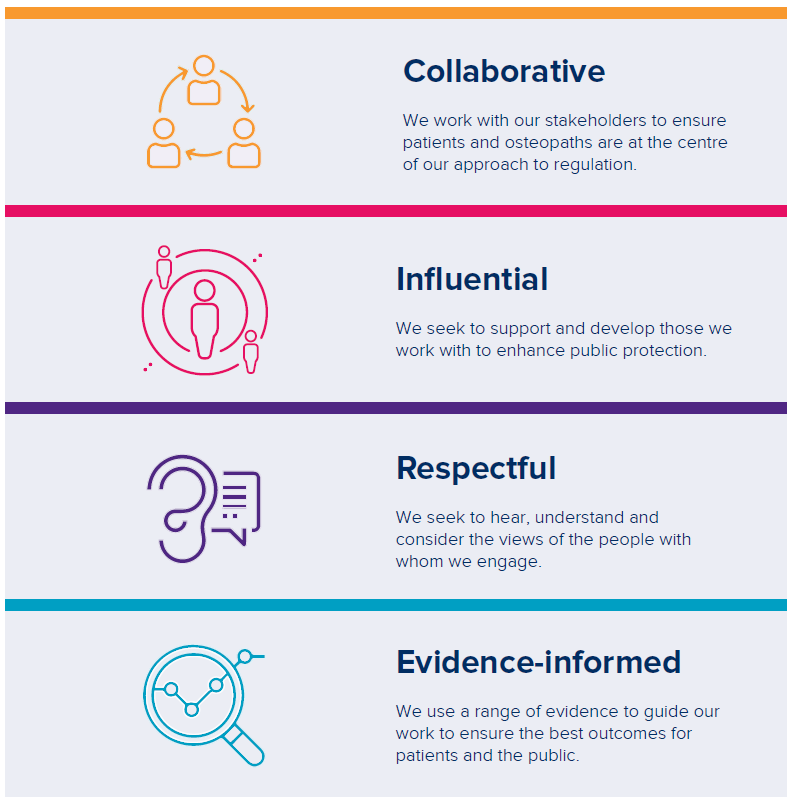
Our intent is to lead with integrity, listen with curiosity, and act with purpose. We consider this is aligned to our organisational values which are:
Data matters in EDIB because it shows the truth, not the assumptions. Without it, bias can stay hidden and inequality can go unchallenged.
Good data turns vague intentions into targeted action. It tells us where the gaps are, whether change is happening and where we need to push harder. Data is how EDIB becomes real, measurable and accountable.
But, as a small regulator we have a significant challenge. Small data sets can only tell part of the story. They are vulnerable to distortion; they cannot reliably show patterns and they make it hard to separate genuine trends from noise. You cannot draw confident conclusions from small data sets that do not stand up to scrutiny.
This is why time matters. Building larger, more complete data sets gives us the statistical strength to spot real disparities, track change and make decisions we can defend. Robust data isn’t quick, but it is essential for credible insights.
It is for this reason that where data held is fewer than 10, we would not publish this information as it potentially makes individuals identifiable.
What are some of the data sets that we hold?
We hold data across the following areas of our work, which allows us to draw insights and learning:
- EDI monitoring data collected from registrants
- EDI monitoring data collected during non-executive recruitment campaigns
- EDI monitoring data about our staff and non-executives
- Our biennial staff survey
- Our quarterly workforce data
- Website accessibility data
Why do we collect these data sets?
EDI monitoring data collected from registrants
| Why we are collecting this information? | How will the information be used? | What happens next? | How will we try to make a difference? |
| We collect EDI information from osteopaths so we can better understand the profession we regulate and make sure our work is fair, inclusive and evidence-informed. The information helps us identify whether different groups experience our regulatory processes differently and whether there are barriers that may prevent some people from engaging with us or accessing our services. | We will analyse the data across all of our work, including fitness to practise, as this helps us understand: who makes up the osteopathic profession; whether different groups experience different outcomes; where barriers or inequalities may exist; and where we need to take action to improve fairness and inclusion. | The data informs decisions, shape policies and identify priorities for improvement. Findings will be reported through our governance processes, and where the data highlights areas of concern, we may: review policies, processes and guidance; improve accessibility and communication; undertake further research; develop targeted initiatives; and set objectives and measures to track progress over time. | By collecting and analysing this data over time, we will be able to measure progress, identify trends and assess whether our actions are improving fairness, accessibility and inclusion across our regulatory work. Our aim is to ensure that everyone who interacts with the GOsC is treated fairly, and that our decisions are informed by evidence rather than assumptions. |
EDI monitoring data collected during non-executive recruitment campaigns
| Why we are collecting this information? | How will the information be used? | What happens next? | How will we try to make a difference? |
| We collect EDI information from people applying for our non-executive roles so that we can understand who applies to join our governance structure and whether our recruitment processes are attracting a diverse range of candidates. | We analyse the data at each stage of the recruitment process, from application through to appointment. This helps us identify whether any groups are under-represented or experience different outcomes during recruitment. The information also helps us understand whether we are reaching people from a broad range of backgrounds. | The data is reviewed after each recruitment campaign and helps us evaluate the effectiveness of our outreach, advertising, selection processes and appointment decisions. Where we identify barriers or under-representation, we can take action to improve future campaigns. This may include changing how we promote opportunities, widening our recruitment channels, reviewing selection processes or providing additional support for applicants. | By monitoring recruitment data over time, we can track trends, measure progress and assess whether we are helping to attract a more diverse pool of applicants. Our aim is to ensure that talented people from all backgrounds can see a place for themselves in our governance and have an equal opportunity to contribute to our work. |
EDI monitoring data about our staff and non-executives
| Why we are collecting this information? | How will the information be used? | What happens next? | How will we try to make a difference? |
| We collect EDI information from our staff and non-executives so that we can better understand the people who work for and with us to ensure GOsC is inclusive, representative and fair. | The data helps us understand the diversity of our workforce and governance structure and identify where particular groups may be under-represented. | The information is reviewed through our governance and reporting arrangements and helps us measure progress against the commitments set out in our EDIB Framework. Where the data highlights areas for improvement, we can take action to strengthen recruitment practices. | By monitoring this information over time, we can identify trends, measure progress and understand whether our actions are helping to create a more inclusive organisation. Our aim is to build a workplace and governance culture where people from all backgrounds feel valued and respected. |
Our biennial staff survey
| Why we are collecting this information? | How will the information be used? | What happens next? | How will we try to make a difference? |
| Every two years we ask our staff to share their views and experiences of working at the GOsC. The survey helps us understand what is working well, where improvements are needed and how colleagues experience our culture. | The survey provides valuable insight into areas such as wellbeing, engagement, leadership, communication, inclusion and organisational culture. It gives staff a structured opportunity to share honest feedback and helps us understand trends and emerging issues. | Survey findings are reviewed by senior leaders and reported through our governance arrangements, before we openly report the results to our staff team. The results are used to identify improvement so we can strengthen the organisation and the experience of those who work within it. | By repeating the survey over time, we can track progress, measure the impact of actions we have taken and understand whether colleagues feel the organisation is becoming more inclusive, supportive and effective. Our aim is to listen, learn and act on what our staff tell us, so that we continue to build a positive, high-performing and inclusive culture. |
Our quarterly workforce data (including turnover, sickness rates etc.)
| Why we are collecting this information? | How will the information be used? | What happens next? | How will we try to make a difference? |
| We collect workforce data, including information about staff turnover, sickness absence and workforce stability, so that we can understand the health of our organisation and identify trends that may affect our ability to deliver our work effectively. | The data helps us understand how the health of the organisation and whether there are any emerging issues we need to address. By monitoring trends over time, we can identify areas of strength, spot potential risks early and better understand the experiences of our workforce. | The information is reviewed at each meeting of the People Committee. Where trends indicate areas for improvement, we can take targeted action to support staff, strengthen retention, improve ways of working and ensure the GOsC remains a positive place to work. | By monitoring workforce measures over time, we can assess whether our actions are helping to maintain a healthy, engaged and resilient organisation. Our aim is to create an workplace where people feel valued and able to do their best work. |
Website accessibility data
| Why we are collecting this information? | How will the information be used? | What happens next? | How will we try to make a difference? |
| We collect website accessibility data to understand how people access and use our digital services and to identify barriers that may prevent some users from accessing information or completing key tasks. Accessibility matters because people cannot use what they cannot access. | The data helps us understand how accessible our website is for different users, where improvements are needed and whether our content, systems and services meet recognised accessibility standards. | Accessibility data is reviewed as part of our ongoing website and digital improvement work. It helps us prioritise changes, address known barriers and improve the accessibility, functionality and user journeys. The findings also support compliance with accessibility requirements. | By monitoring accessibility data over time, we can measure progress, identify recurring issues and assess whether changes are improving access to our digital services. Our aim is to ensure that our digital front door is open to everyone, regardless of their circumstances. |
Our EDIB work is underpinned by robust governance processes because they are the structure that turns intention in consistent, deliverable action. Our governance processes ensure EDIB activity is embedded, not as an add-on, but as a core requirement of work.
The Chief Executive and Registrar is responsible for overseeing the GOsC’s EDIB work, held to account by the Council. All Committees (Policy and Education, Audit and People and Council) consider EDIB implications related to every item they consider, which is important as this embeds thinking and creates the right culture.
We place importance on external verification of our work, including but not limited to the Professional Standard Authority’s (PSA) assessment of our performance through the Annual Performance Review process. The Standards of Good Regulation include a Standard on EDI.
In 2025-26, the PSA determined that we did not meet the Standard of Good Regulation related to EDI. We are disappointed by the finding and we do not agree with the PSA’s judgement that Standard 3 is not met.
We know that demonstrating real change in the EDI area requires meaningful consideration and time, and we are committed to working with and learning from our peers and experts in this field. We continue to work collaboratively with the PSA, but we are seeking their assistance to help us understand what good looks like, and how we can better work together to achieve this.
Read the PSA’s report on the performance of the GOsC in 2025-26 and our response to PSA’s review.
Since 2024, what have we done around our EDI governance and why did we do it?
During 2024 we collected accurate EDI monitoring data for senior leadership, Council, committees, decision-makers and fitness to practise panellists.
| Why have we undertaken this activity? | How will the information be used? | What happens next? | How will we try to make a difference? |
| In 2024, we collected EDI information to helps us understand who makes up our governance and decision-making structures. | The data helps us assess representation, identify gaps and understand whether people from different backgrounds are participating in and contributing to our work. | We will continue to review this information regularly and use it to inform our EDIB Framework, recruitment activity and governance reporting. | Where the data identifies opportunities to improve representation, we will take action through our recruitment and outreach. Our aim is to ensure our governance and decision-making structures benefit from a broad range of perspectives. |
Collected robust EDI recruitment data for governance appointments
| Why have we undertaken this activity? | How will the information be used? | What happens next? | How will we try to make a difference? |
| We collect EDI information during recruitment campaigns for governance roles so that we can understand who is applying and whether we are attracting a diverse range of talented candidates. This helps us assess whether our opportunities are accessible, open and welcoming to people from all backgrounds. | The data is used to understand the diversity of applicants at different stages of the recruitment process and to identify where particular groups may be under-represented. It also helps us build a broader picture of diversity across our governance structure when considered alongside our wider EDI monitoring data. | We review the data after each recruitment campaign and use the findings to inform future recruitment activity. As a small organisation, we consider this information alongside other sources of evidence to help us identify trends and draw meaningful conclusions. | Where the data identifies opportunities for improvement, we will take steps to widen participation and remove barriers to applying for our roles. Our aim is to ensure that people from all backgrounds can see themselves reflected in our governance structures and feel encouraged to contribute to the work of the GOsC. |
In 2025 we carried out an independent audit of our governance recruitment processes
| Why have we undertaken this activity? | How will the information be used? | What happens next? | How will we try to make a difference? |
| We commissioned an independent review to provide assurance that our approach was fair, inclusive and effective. | The review provides an independent assessment of the strengths of our recruitment processes and identifies opportunities for further improvement. | The findings will be used to refine and strengthen our recruitment arrangements. | The review found that our recruitment processes are inclusive, robust and equitable. It also recognised the progress we have made in attracting diverse candidate pools and securing diverse shortlists for non-executive appointments. We will build on this progress by continuing to improve our processes. |
In 2024 we updated our Equality Impact Assessment (EIA) template and provided training on how to complete an EIA
| Why have we undertaken this activity? | How will the information be used? | What happens next? | How will we try to make a difference? |
| We updated our EIA template and provided training to staff on how to complete EIAs effectively to strengthen the way we consider equality, diversity and inclusion when making decisions and developing policies. | EIAs help us identify whether a policy, process or decision could affect particular groups differently and whether there are opportunities to improve fairness, accessibility and inclusion. | We continue to complete EIAs when developing new policies or making significant changes to existing ones. The findings inform decision-making and help shape the design and implementation of our work. | By embedding EIAs into our decision-making processes, we aim to reduce barriers, minimise unintended impacts and ensure our policies and services are accessible and fair for everyone who interacts with the GOsC. |
In 2026 we submitted evidence to the Mann Review which was investigating antisemitism and other forms of racism within the NHS and its regulatory bodies.
| Why have we undertaken this activity? | How will the information be used? | What happens next? | How will we try to make a difference? |
| As a public body, we have a responsibility to ensure that our governance, decision-making and regulatory processes are fair and free from bias. | Our contribution helps us reflect on our own policies, processes and organisational culture, while supporting wider efforts to tackle racism, discrimination and exclusion across the healthcare sector. | We will review the findings and recommendations of the Mann Review and consider what they mean for our regulatory functions and our ongoing EDIB work. | We are committed to creating a culture that challenges antisemitism, racism and all forms of discrimination. Where the review identifies opportunities for improvement, we will take appropriate action to strengthen fairness, inclusion and public confidence in our work. |
In 2026 we signed up to the Workforce Race Equity in Health and Social Care: Shared Principles.
| Why have we undertaken this activity? | How will the information be used? | What happens next? | How will we try to make a difference? |
| We did this because we have a responsibility to consider how racism and inequality may affect osteopaths, patients and the regulation of the profession. | The principles provide a framework to help us reflect on our own policies, decision-making and regulatory processes, and to consider how we can promote fairness and tackle racism in our area of work. | We will use the principles to inform our ongoing EDIB work and consider how they can be applied within the context of osteopathic regulation. | By adopting these principles, we are making a public commitment to challenge racism, learn from good practice across the regulatory sector and continue building a fairer and more inclusive organisation for everyone who interacts with the GOsC. |
We work closely with osteopaths, patients and educators because good regulation depends on real experience, not assumptions. For us, regulation is done best when it involves people, dialogue and collaboration.
EDIB is not a side project for us: it is how we make sure our standards are fair, our decisions are trusted and the profession is equipped to deliver truly person‑centred care.
By listening and acting on what we learn, we can spot where barriers exist and work with the sector to remove them. This supports osteopaths to continue to perform to a high standard where patients receive safe, compassionate care every time.
Since 2024, what have we done with our sector on EDIB and why did we do it?
In 2025, we issued a call for feedback on the Osteopathic Practice Standards ahead of a consultation to be launched late 2026.
| Why have we undertaken this activity? | How will the information be used? | What happens next? | How will we try to make a difference? |
| We wanted to hear from osteopaths, students, patients and others about how the standards are working in practice and where improvements may be needed. | The feedback helps us understand what is working well, what could be improved and whether there are gaps in the current standards. It also helps us identify emerging issues and changes in professional practice that should be reflected in future standards. | We will use the feedback to inform the review of the Osteopathic Practice Standards and the consultation that will take place in 2026. Consultation views will help shape proposals for change. | We want to ensure the Osteopathic Practice Standards remain relevant, effective and reflective of modern practice. This includes considering EDIB so that the standards support safe, fair and inclusive care for all patients and osteopaths. |
In 2025 we updated and published guidance for students and education providers relating to studying with a disability or health condition.
| Why have we undertaken this activity? | How will the information be used? | What happens next? | How will we try to make a difference? |
| We recognise that people can study and practise osteopathy successfully while managing a disability or health condition, and we wanted to provide clear and practical guidance to support them. | The guidance helps students, education providers and the GOsC better understand how health conditions and disabilities can be supported throughout education and training. | The guidance will be used by students and education providers to support discussions about reasonable adjustments, student wellbeing and successful progression through training. | Our aim is to remove unnecessary barriers and encourage an inclusive learning environment where people with disabilities or health conditions can thrive within osteopathic education and training. |
We developed plans for educator roadshows which will happen in 2026.
| Why have we undertaken this activity? | How will the information be used? | What happens next? | How will we try to make a difference? |
| The roadshows will provide an opportunity to work with education providers on key challenges and opportunities facing osteopathic education. | The roadshows will help us explore the findings of the Under Represented Groups Experiences of Education and Training (UrGEnT) research and consider how those findings can be applied within osteopathic education. | In 2026, we will work with education providers to discuss the research findings, share good practice and identify practical actions that could help reduce inequalities in education and training. | We want to ensure that all students have an opportunity to succeed, regardless of their background or personal circumstances. |
Following a consultation we made professional boundaries and inclusive practice mandatory elements of our CPD scheme and developed resources to support the profession to meet these requirements.
| Why have we undertaken this activity? | How will the information be used? | What happens next? | How will we try to make a difference? |
| We did this because expectations of healthcare professionals continue to evolve, and it is important that osteopaths understand how issues such as discrimination, inclusion and professional behaviours can affect patients, colleagues and public confidence. | The CPD scheme provides a practical way for osteopaths to reflect on their practice, develop their understanding and demonstrate that they are keeping their knowledge and skills up to date in these important areas. | We have developed a range of resources to support osteopaths in meeting these requirements. These resources are designed to suit different learning styles, levels of experience and approaches to learning, while maintaining consistent expectations across the profession. | We aim to support a profession that is informed, reflective and inclusive. Our goal is to help osteopaths provide safe, respectful and person-centred care to the diverse communities they serve. |
Demonstrated visible, inclusive leadership, for example through increased social media around religious and culturally important events and through GOsC attendance at Pride in London.
| Why have we undertaken this activity? | How will the information be used? | What happens next? | How will we try to make a difference? |
| We recognise that policies and frameworks alone do not create an inclusive culture. Visible leadership is important in demonstrating our commitment to EDIB to show that we value the diversity of the osteopathic profession and the patients osteopaths serve. | These activities help us engage with different communities, raise awareness of important issues and demonstrate our organisational values in practice. | We will continue to look for opportunities to celebrate diversity, engage with different communities and promote inclusion through our communications, engagement activities and leadership behaviours. | By being visible and active in our support for diverse communities, we aim to foster a culture where people feel respected, valued and included. |
Bias damages fairness. If our processes allow it, consciously or not, we risk decisions that are inconsistent, unjust and impossible to defend. The credibility of regulation depends on being able to show that judgement is evidence-informed and not based on assumptions.
Removing discrimination is active work. When we are transparent, consistent and deliberately anti‑bias, osteopaths will experience regulation as fair and patients experience care as safe. This is essential to trust, and trust is essential for effective regulation.
Our performance is assessed annually by the Professional Standards Authority (PSA) against the Standards of Good Regulation. In 2025-26, the PSA determined that we did not meet the Standard of Good Regulation related to EDI. We are disappointed by the finding and we do not agree with the PSA’s judgement that Standard 3 is not met.
We know that demonstrating real change in the EDI area requires meaningful consideration and time, and we are committed to working with and learning from our peers and experts in this field. We continue to work collaboratively with the PSA, but we are seeking their assistance to help us understand what good looks like, and how we can better work together to achieve this.
Read the PSA’s report on the performance of the GOsC in 2025-26 and our response to PSA’s review.
Since 2024 what have we done to ensure our processes are free from bias and discrimination and why did we do it?
We implemented a new CRM system which collects a comprehensive set of EDI data from registrants at the point of renewal.
| Why have we undertaken this activity? | How will the information be used? | What happens next? | How will we try to make a difference? |
| We implemented a new CRM system to modernise how we work and to enable the collection of comprehensive EDI data. Having robust data helps us better understand the profession we regulate and provides a stronger evidence base for assessing fairness across our regulatory activities. | The data will help us understand the demographics of the Register and assess whether our policies, processes and decision-making have a disproportionate impact on particular groups. It will also help us identify trends, target improvement activity and strengthen our understanding of the profession over time. | By end January 2027, we will hold EDI data for the full Register through the renewal process. This will provide the first comprehensive dataset of its kind for the osteopathic profession and allow us to begin detailed analysis. | We will use the data to identify areas where barriers, inequalities or different outcomes may exist and to inform future activity. Our aim is to ensure that our work is evidence-based while providing greater confidence that our regulatory processes are free from bias and discrimination. |
Revised Fitness to Practise guidance materials to explicitly reference racist and discriminatory behaviour.
| Why have we undertaken this activity? | How will the information be used? | What happens next? | How will we try to make a difference? |
| We updated our fitness to practise guidance to ensure it reflects modern expectations of professional behaviour and supports fair, consistent and evidence-based decision-making. | The guidance helps screeners, Investigating Committee members and hearing panels identify and consider allegations involving racist or discriminatory behaviour when making regulatory decisions. | The revised guidance is now being used across the fitness to practise process and will continue to be reviewed to ensure it remains up to date and reflects developments in professional practice and wider society. | By making explicit reference to racist and discriminatory behaviour in our guidance, we aim to support fair decision-making, promote public confidence and make clear that such behaviour is taken seriously within our regulatory processes. |
We provide EDI training for decision-makers.
| Why have we undertaken this activity? | How will the information be used? | What happens next? | How will we try to make a difference? |
| We provide annual EDI training for our staff, fitness to practise panel members and governance members because fair decision-making depends on recognising and managing bias. | The training helps decision-makers understand EDI issues and apply professional judgement in a fair, consistent and inclusive way. | We will continue to provide regular EDI training and development opportunities. We have also delivered specialist training to Professional Conduct Committee members on supporting vulnerable participants and managing hearings in a fair and inclusive manner. | By equipping decision-makers with the knowledge and skills we aim to strengthen the fairness, consistency and inclusiveness of our regulatory decision-making and maintain public confidence in our processes. |
We have made Boundaries and Inclusive Practice mandatory elements of our CPD scheme, supported by new layered guidance.
| Why have we undertaken this activity? | How will the information be used? | What happens next? | How will we try to make a difference? |
| We did this because healthcare professionals need to understand how issues such as discrimination, inclusion and professional boundaries can affect patients, colleagues and public confidence. | The CPD scheme provides a practical way for osteopaths to develop their understanding of these issues and reflect on how they apply them in practice. | We have developed a range of supporting resources and guidance to help osteopaths meet these requirements. The resources are designed to suit different learning styles, levels of experience and preferences for learning. | Our goal is to help osteopaths provide safe, respectful and person-centred care to the diverse communities they serve. |
Subjected our FTP processes to independent audits.
| Why have we undertaken this activity? | How will the information be used? | What happens next? | How will we try to make a difference? |
| We use independent audits and external scrutiny to test the fairness, quality and consistency of our fitness to practise processes. Independent assurance helps us understand what is working well, identify areas for improvement and provide confidence that our decisions are based on evidence rather than assumption. | The findings help us assess whether our processes are operating fairly, consistently and effectively. They also provide assurance that equality, diversity and inclusion considerations are being appropriately reflected in our decision-making. | We review the findings and recommendations from audits and use them to strengthen our processes. Recent audits identified a number of areas of good practice and recommended the development of a formal escalation procedure for fitness to practise cases, which will be taken forward as part of our continuous improvement work. | By inviting independent challenge and acting on the findings, we aim to maintain fair, robust and transparent fitness to practise processes. Our goal is to ensure that everyone involved in our regulatory processes can have confidence that cases are handled consistently, proportionately and without bias. |
We take pride in our work to embed EDIB throughout all that we do. Our planned and structured approach ensures that we can move towards 2030 delivering positive change.
The EDIB Framework set out a number of actions we intended to take within the first 24-months of the Framework, up to July 2026.
We have met 100% of the actions outlined in the EDIB Framework. 83% of the actions were met on time.
Delivering on what we said we would do.
- We consulted on, analysed responses to, and published guidance for students with a disability or health condition.
- We carried out a full comprehensive review, and made amendments to, all fitness to practise guidance both at the initial and hearings stages of the fitness to practise process, to ensure the guidance adequately addresses allegations that involve racist and discriminatory behaviours.
- We implemented a new CRM system which, when osteopaths renew their registration, collects equality monitoring data across the full range of protected characteristics.
- We completed a website technical scoping activity; undertook a tender exercise and appointed a website provider to redevelop the GOsC websites, making them more accessible and which better meets the needs of those who use them. The new websites will be introduced in the summer of 2026.
- We completed a biennial staff survey, presenting results and actions to the GOsC People Committee.
- We reviewed our recruitment processes for staff and non-executives to ensure our approach is inclusive, does not contain barriers to entry and ensures we attract high-quality, diverse talent.
- We ensured that mandatory EDI training is in place for any new member of staff and non-executive, and that training is reviewed and refreshed frequently.
- We have developed a new approach to reporting on our EDIB activity.
We have set out below a number of actions for delivery by June 2027. Council are asked to consider and approve the actions. The actions are:
Data
| Complete the collection of the EDI monitoring data from osteopaths on the Register and commence a detailed analysis of this and how it relates to our regulatory activities. Key performance indicators: 90% completion for age, sex and ethnicity and 80% completion for disability, sexual orientation, religion or belief, gender reassignment and pregnancy and maternity by June 2027. NB: Prefer not to say is recognised as a valid response and not treated as missing data. Annual analysis of non-disclosure patterns will be undertaken to understand the barriers to voluntary disclosure and identify opportunities to improve confidence in EDI monitoring. |
| Re-run the internal 2024 EDI monitoring data survey so that we hold up-to-date, accurate data across all of the protected characteristics for staff (c.30 people) and members and decision makers within our governance structure (37 members); analyse results and consider analysis against population census data to determine where we might be over and under-represented. Key performance indicator: Achieve and maintain 90% completion of EDI monitoring information for governance members. Achieve 80% completion of EDI monitoring information for staff, supported by activities to improve understanding, trust and confidence in the EDI data collection by June 2027. NB: Prefer not to say is recognised as a valid response and not treated as missing data. Annual analysis of non-disclosure patterns will be undertaken to understand the barriers to voluntary disclosure and identify opportunities to improve confidence in EDI monitoring. |
| Continue to take steps to explore how to enhance data from complainants in our fitness to practise processes. Key performance indicator: Increase complainant EDI data completion year-on-year and achieve a minimum completion rate of 5% by June 2027. |
| Explore with the smaller healthcare regulators of primarily independent practitioners; the potential for sharing and aggregating data in order to make more meaningful, statistically relevant data sets, addressing a challenge we, and others, face. Key performance indicator: develop and agree a joint proposal with at least one other regulator for aggregating data sets and/or benchmarking of EDI data to improve statistical robustness, trend analysis and insight within small regulators. |
| Continue to ensure a diverse range of talented individuals (lay and osteopaths) apply for our governance vacancies through analysis of the EDI recruitment data we collect. Key performance indicator: More than 90% of applicants completing EDI forms, including prefer not to say, where chosen applicant diversity is maintained or improved over the three-year strategy period, including improvement in the representation of ethnic minority, disabled and other underrepresented groups within governance applicant pools, taking account of applicant numbers and relevant benchmarks. |
Culture, Education and Standards
| Run the 2026 staff survey exploring our staff culture and psychological safety: analyse results and present findings/actions arising to our People Committee. Key performance indicator: Staff survey completion rate above 80% by January 2027. Analysis considered by People Committee. |
| Training in EDIB and cultural humility for all staff and governance members and decision-makers. Key performance indicator: 100% completion rate for staff and governance members by June 2027. |
| Publication of inclusive practice: EDIB resources for osteopaths to support implementation of mandatory requirements in relation to inclusive practice. Key performance indicator: Inclusive practice EDIB resources published and disseminated to all relevant interested parties by November 2026. |
| Strengthen EDIB and cultural humility requirements in the Osteopathic Practice Standards for consultation. Key performance indicator: Publication of consultation by December 2026. |
| Develop an action plan for taking forward our commitment to the Workforce Race Equity in Health and Social Care: Shared Principles. Key performance indicator: Action plan developed by June 2027. |
| Review the Mann Review Recommendations and develop a plan for implementing relevant actions throughout 2026-27 including collaborative discussions with other regulators including through the EDI inter-regulatory group. Key performance indicator: Report to the Department of Health and Social Care on progress against the recommendations by October 2026 with a more detailed assessment by April/May 2027. |
| Undertake thematic review of EDI in education building on engagement with educational providers through workshops and interviews. Key performance indicator: Publish Thematic Review by June 2027 with recommendations sharing good practice. |
Communications and visible commitment to inclusivity
| Continue to demonstrate our visible, inclusive leadership through our actions such as recognising religious and culturally important events on social media and through our attendance and participation in Pride in London. Key performance indicator: Demonstrating inclusion through our communications activities to all groups. |
Assurance, reflection and learning
| Continue to subject our regulatory work to independent audits as we are a learning organisation which sees improvement as being core to the way we work. Key performance indicator: conduct at least 4 independent audits during 2026-27 and agree timelines for addressing any action points arising. Audit Committee to oversee this activity. |
| Ensure the training we provide to members of our governance structure and fitness to practise panel members supports quality decision-making, with specific relevance to the Mann Review Recommendations. Key performance indicator: 100% compliance with training by June 2027. |
| Develop a formal escalation procedure for fitness to practise cases that defines the criteria for escalation and which ensures fairness of decision-making. Key performance indicator: the escalation procedure will be developed taking into account views of individuals with appropriate lived experience. |
| Review our new website against the Witness to Harm Research to assess whether any further improvements can be made to reduce barriers to complaints. Key performance indicator: review the outcome of the Witness to Harm research and apply learning; assess improvements made to reduce barriers to complaints. |