Learning from other health professionals in education and in practice
Teresa Harvey discusses the benefits and challenges of collaborative working between health professionals and why interacting with other professions in education is important for patient care.
After working for 10 years as a nurse and ward Sister specialising in spinal medicine and neurosurgery, I qualified as an osteopath from the British School of Osteopathy in 1998. After graduating and having worked as an associate in the UK and abroad, I set up The Osteopaths in Paisley, Scotland, which has evolved into a multi-disciplinary clinic with a team of 12 healthcare professionals.
As well as osteopathy, the clinic offers services such as physiotherapy, medical acupuncture, personalised exercise rehabilitation programmes, spinal decompression therapy, massage therapy, and specialist clinics for hypermobility and scoliosis.
In a multi-disciplinary setting, collaboration between health professionals is a vital aspect of what we do. We are responsible for making sure patients can access the most appropriate care to help them feel better. All team members are happy to inter-refer if they feel another service at the clinic meets the patient’s specific needs.
Working jointly with other health professionals
We developed a relationship with the physiotherapy programme at Glasgow Caledonian University and routinely have final year students undertake placements with us as part of their training. Following graduation, many have continued to work with us.
We hold quarterly practice meetings which provide an invaluable opportunity to share what we have learned from our patients and from recent CPD lectures. Anonymised patient case studies are often discussed to enable the team to gain insights into each other’s specialist knowledge and experience and to help critically inform our clinical practice.
These meetings are hugely beneficial and help to inform our approach to patient care. By recognising the skills of other healthcare professionals, we can ensure our patients have access to the most appropriate treatment for their condition. We are happy to work with a patient together to better understand their problem and to help us support patients in their recovery.
Collaborative working to enhance the patient journey
By working in collaboration, we are able to treat and manage patients from the start of their journey and throughout their ongoing care. For example, I recently treated a patient before they had hip replacement surgery. After surgery the patient was transferred to a physiotherapist who was able to provide a more focused post-surgical rehabilitation programme. Our skills as an osteopath and physiotherapist complemented each other and led to better outcomes for the patient.
Breaking down the barriers of communication
Sharing knowledge and working alongside other health professionals can sometimes be challenging. COVID-19 meant that in-person quarterly meetings at the clinic came to a halt. However, I was able to use online methods such as WhatsApp to continue talking to the team and we were even able to have our Christmas party over Zoom!
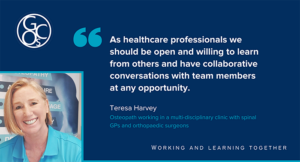
I have also been able to overcome some of the barriers to collaborative working by sitting down with team members during clinic breaks to informally chat about cases and encourage knowledge-sharing. As healthcare professionals we should be open and willing to learn from others and have collaborative conversations with team members at any opportunity.
Interaction between students to support future collaboration and patient care
To promote joint working between health professionals for the benefit of patients, I believe there should be more interaction between students of different professions while in education. There is a degree of mistrust and generalisation about what each profession does and this can hinder beneficial collaborative working once students go on to become registered practitioners. I was encouraged to hear about a recent initiative between the UCO and BCOM/ESO that enabled physiotherapy students to observe student clinics during their summer placements. From study to practice, students and qualified practitioners should be open and willing to learn from each other so that patients can truly get the best care for their condition.
About Teresa
Teresa Harvey is an osteopath with a wealth of experience working in multi-disciplinary clinics with spinal GPs and orthopaedic surgeons. Teresa qualified from the British School of Osteopathy (now University College of Osteopathy) with a First Class Honours degree in 1998. Prior to this Teresa worked as a nurse and ward Sister having completed a post-graduate course in Neuroscience at Addenbrooke’s, a Cambridge University teaching hospital. Teresa currently works at The Osteopaths, with three clinics in Glasgow and the surrounding area, including a range of other health professionals.
Share this post
Your next read
-
Shared learning, fresh thinking: the Educator Roadshow 2026
Nikky Godfrey, Interim Head of Education at the professional membership body the Institute of Osteopathy and Executive Administrator of the Council for Osteopathic Educational Institutions On 4 July 2026, educators…
-
Osteopathy concerns: An opportunity for learning and reflection
Following the publication of the latest annual concerns report from the National Council for Osteopathic Research, Fiona Browne, Director of Education, Standards and Development reflects on the nature of concerns…
-
How our role as regulator can support and develop the future of the osteopathy profession
Fiona Browne, Director of Education, Standards and Development, explains how the GOsC is working collaboratively to support the future of osteopathy in the UK.