
In-person hearings
We hold most of our hearings online, however, on some occasions hearings will be held in-person. Here you will find everything you need to know about what happens when a hearing is held in-person, including guidance for osteopaths and witnesses.
Guidance for osteopaths
This guidance has been created to support osteopaths preparing for and attending a hearing before our Professional Conduct Committee or Health Committee.
You will have received a letter, which is often attached to email, from your caseworker telling you that we have made a decision to hold your hearing before our Professional Conduct Committee or Health Committee, in person.
Your caseworker will have asked you to complete a listings questionnaire which will ask any admissions as to the allegation but also whether you have a preference on how the hearing is held (ie in-person, remote or hybrid). It is also important that you let us know, before the hearing, about any accessibility needs or other needs that you have (for example, wheelchair access, a hearing-loop system, for the hearing to be held in Welsh, or a sign or language interpreter), so that we can make the necessary arrangements.
When your case is referred by the Investigating Committee, your caseworker will send you or your legal representative (or both of you) an email with a listings questionnaire requesting information that is relevant to the length and timing of the final hearing.
We will use the information you provide in the questionnaire to more accurately assess how long it will take us to complete the case and when it can be listed for hearing. If possible, we will try to consider your availability and that of our witnesses when listing your case for hearing and give you as much notice as possible. We aim to list hearings within six months of the case being referred by the Investigating Committee. You can find out more about fitness to practise timelines in the Investigation Process section of the website.
We will then send you or your legal representative (or both of you) a notice of hearing, and a hearing schedule, at least 28 days before the hearing. The notice of hearing confirms the following information:
- the date, time and place of the hearing
- the names of the witnesses that we intend to call at the hearing
- the names of the committee members that will hear your case
- confirmation that you have a right to attend the hearing or be legally represented (or both)
We will also give you a copy of our bundle of evidence at least 28 days before the hearing. This will contain the formal allegation and the detailed charges (known as the ‘factual particulars’), and all of the evidence that we intend to rely on at the hearing.
The venue for the hearing will be confirmed in good time.
You or your legal representative (or both of you) will also receive an email from the hearings officer or clerk telling you the date by which you need to do the following (if you have not done so already):
- confirm the names of the witnesses that you intend to call at the hearing
- submit your skeleton argument (a written document given to the Professional Conduct Committee before the hearing which summarises the issues in your case)
- submit all of the evidence that you intend to rely on
At the start of the hearing, the clerk will take you and your legal representative into the hearing room and show you where to sit.
Please make sure your mobile phone is switched off before you enter the hearing
room.
Hearing room set up:
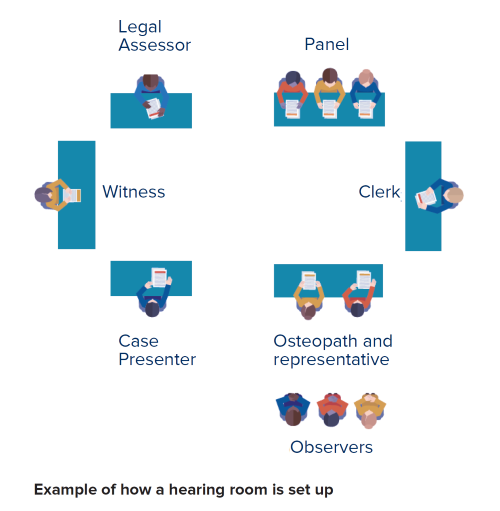
The hearing will begin with the chair of the Professional Conduct Committee introducing themselves and everyone else who is present in the room.
You or your legal representative will be asked to confirm your name.
Our case presenter will be asked to read out the allegation about you.
The Chair of the Committee will then ask you to confirm whether you admit to any of the facts alleged. If you do admit to any of the facts alleged, those facts will be found proved.
If you admit to all of the facts alleged, the Chair will formally announce that all the facts have been admitted and are proved. The Committee will then move on to the next stage of deciding whether the facts proved amount to unacceptable professional conduct.
If you dispute some or all of the facts alleged, our case presenter will formally open the case.
The case presenter will present the evidence to support the GOsC’s case first. They may call any witnesses in the case and ask them questions once the witnesses have taken an oath or an affirmation. This is called examination-in-chief .
You or your legal representative will then have an opportunity to ask our witnesses any questions. This is called cross-examination.
Once you and your legal representative have asked all your questions, the case presenter may ask any witnesses further questions.
The Committee may then ask the witnesses some questions.
Once the witnesses have given evidence, the Chair will formally release them as witnesses. Some witnesses may choose to stay for the rest of the hearing. If they do, they will be asked to sit in the seating area for observers.
After all of our witnesses have given their evidence, the chair will ask you or your legal representative to open your case.
At this stage you or your legal representative may call your witnesses to give evidence under oath according to their religious belief, or an affirmation (a solemn declaration) if the witness does not want to take an oath. You or your legal representative will need to ask your witnesses questions first. Our case presenter will then be given the opportunity to ask your witnesses questions.
The committee may also have questions for your witnesses.
You may also give evidence under oath (or affirmation). If you give evidence, the case presenter and the committee can ask you questions.
Closing Statements
Once you and, if it applies, your witnesses, have given your evidence and are released as witnesses, both parties will be invited to make closing statements about the case. The case presenter will make their closing statement first, followed by you or your legal representative.
The committee will receive legal advice from the legal assessor before it retires to make a decision on the facts of the case.
The Committee goes into private session to make its decision, which will be in three stages.
The legal assessor will be present in the room and may help the committee to draft its decision. However, the legal assessor plays no role in the decision making process.
Stage 1
If there is any dispute about some or all of the facts alleged, the committee will need to first consider whether it finds those facts proved. The GOsC has to prove the case against you. The standard of proof which applies is called the ‘balance of probabilities’. This means that the committee will only find the alleged fact ‘proved’ if it considers that it is more likely than not that it is correct.
If the committee does not find any of the facts proved it will ask both parties to return to the hearing room, where it will formally announce the decision and conclude the case.
If the committee finds some or all of the facts proved, it will ask both parties to return to the hearing room so that the chair can formally announce the decision and reasons. The hearing will then move on to stage 2.
Stage 2
Once the committee has announced its findings, the case presenter and you or your legal representative will be invited to make submissions on unacceptable professional conduct.
The legal assessor may give the committee legal advice and the committee will then retire in private to consider whether the facts found proved amount to unacceptable professional conduct.
After the committee has reached a decision, both parties will be invited into the hearing room and the chair will announce the committee’s decision on unacceptable professional conduct.
Stage 3
If a finding of unacceptable professional conduct is made, the committee will impose one of the following sanctions:
- an admonishment
- a conditions of practice order, which will allow you to continue to work in a limited way
- a suspension order for a period of time
- removal of your name from the Register
When deciding what sanction to impose, the Professional Conduct Committee
will take account of guidance documents.
A variety of people attend the hearing.
The Professional Conduct Committee
The Professional Conduct Committee is made up of three committee members.
There will be at least one osteopath member and one lay member. The chair will be a lay member.
Before the hearing, the Professional Conduct Committee will be given a copy of our bundle of evidence and any documents received from you.
Legal assessor
A legal assessor will also be present to advise the Professional Conduct Committee on matters of law and procedure. The legal assessor will play no part in the decision-making process.
Case presenter and witnesses
Our case presenter and witnesses (the complainant and any other people who have given a statement in the case) will also be present at the hearing. They will be asked to wait in another private waiting room.
Hearings clerk or clerk to the Professional Conduct Committee
A clerk will also be present to help with the smooth running of the hearing.
Public, press and observers
Hearings are usually held in public, unless there is a reason why some or all of the hearing has to be held in private. This means that members of the public (including the press) are also able to attend.
There are seats available at the back of the hearing room where members of the public can sit.
You can bring someone with you for support – perhaps a friend or relative. If you do bring someone with you, they will be asked to sit in the public seating area inside the hearing room.
The Independent Support Service helps support patients, witnesses and osteopaths going through the fitness to practise process. The support that Independent Support Service can provide is available throughout the fitness to practise process and for three months after the case you are involved with concludes.
The clerk will make an audio recording of the proceedings. You will not be allowed to make any personal recordings of the proceedings. Cameras, tape-recording equipment and any other device capable of making a permanent record are not allowed in the hearing room.
You or your legal representative (or both of you) should confirm to your caseworker whether you plan to attend the hearing.
If you decide not to attend the hearing, you can still be legally represented at it. Your caseworker will tell you the outcome.
If you decide not to attend the hearing or be legally represented at it, the Professional Conduct Committee or Health Committee may go ahead anyway.
On the first day of the hearing, you should aim to arrive at least 20 minutes before the hearing is due to start. When you arrive, a member of staff will take you to your private waiting room. If you are legally represented, your representative will also be asked to wait in the same room as you.
Refreshments such as coffee, tea and water will be available while you wait.
Our Fitness to Practise Publication Policy sets out how, and for how long, we publish information relating to the decisions of our fitness-to-practise committees.
We will publish a finding of unacceptable professional conduct made by the Professional Conduct Committee (at a hearing or under the Rule 8 Procedure)
on our website and in the annual Fitness to Practise Report.
We will publish findings made by the Health Committee, but we will not publish information relating to your health or condition.
You can find out how to appeal on the Appeals page.
All parties are encouraged to share feedback about the hearing process on our feedback form which will be provided by the caseworker.
Guidance for witnesses
This guidance provides support for before, during and after a hearing for witnesses. It aims to help witnesses know what to expect. We recognise that each witness is unique, and we will consider their circumstances and requirements, where possible, when attending a hearing in person.
It is likely that you will have provided a witness statement to us relating to a concern we have received about an osteopath. It is our responsibility to prove a case against the osteopath. To do this we must investigate and consider concerns about osteopaths appropriately.
This might involve written witness statements, reports, patient notes, emails and other relevant information. You may need to attend a hearing and give evidence before either a Professional Conduct Committee (PCC) or a Health Committee (HC).
When the decision has been made that you have to give evidence, your caseworker will contact you about the dates when you can attend the hearing. We will try to list hearings on dates most convenient to you. However, this might not always be possible for a variety of reasons including, for example, other witnesses’ availability.
Your caseworker will let you know the date of the hearing as soon as it has been confirmed. We will then make suitable travel arrangements and book overnight hotel accommodation and travel tickets for you if appropriate.
It is also important that you let us know, before the hearing, about any accessibility needs or other needs that you have (for example, wheelchair access, a hearing-loop system, or a sign or language interpreter), so that we can make the necessary arrangements.
Your caseworker will deal with your expenses claim and any questions you may have. Expenses claims can be things you have had to pay for when attending a hearing, such as lunch or travel. However, we do not usually pay for loss of earnings.
We want to make sure that you can give your best evidence, without fear, stress or anxiety. One way we can do this is by making sure that we fully explain the process to you. We can do this in various ways, for example by inviting you to visit the hearing venue beforehand. If you have any questions about giving evidence, you can discuss this with your caseworker. However, it is very important that you do not discuss your evidence with anyone else.
This short video will help you familiarise yourself with the hearing venue. This will give you an idea of what to expect on the day of the hearing. You will see our reception area, the layout of the hearing room, and where you will sit to give your evidence.
We hope that, as you have agreed to provide a witness statement, you will also be willing to go to the hearing. Occasionally, we may ask the committee to issue a witness summons. This means that you could be told you must attend a hearing to give evidence or produce documents. This can happen for any number of reasons, for example your employer may not be willing to give you time off work to go to the hearing. If you are summoned and then do not appear, you may be prosecuted for committing an offence under the Osteopaths Act.
As well as any accessibility requirements you may have, it is also important to let us know if there is anything else that may make it difficult for you to give evidence, such as depression or anxiety or if you experience difficulty in social situations, so that we can make the necessary arrangements.
For example, we can make sure the committee are aware of this and that they ask for frequent breaks during your evidence.
In cases involving allegations of inappropriate sexual behaviour or, for example, if you are elderly or have a disability, we can put in place special procedures that can help you give your evidence more effectively, while aiming to reduce any anxiety you may have. These are often referred to as ‘special measures’ and can include giving evidence from behind a screen or via a video link so you would not have to be in the hearing room while giving your evidence.
You are welcome to bring someone with you – perhaps a friend or relative – to the hearing for support. However, please do not bring children or pets with you. If it’s not possible to leave your children with someone, please make sure you bring another adult with you who will look after the children while you give evidence. The person you have brought along to support you will sit in the public seating area in the hearing room.
The Independent Support Service helps support patients, witnesses and osteopaths going through the fitness to practise process. The support that Independent Support Service can provide is available throughout the fitness to practise process and for three months after the case you are involved with concludes. Find out more about the Independent Support Service.
Before you go to the hearing, remember to:
- make sure you have thoroughly read your statement and any other relevant documents
- carefully check the details of your journey and give yourself plenty of time to reach the hearing venue in good time
- bring your reading glasses (if needed)
- let us know if there is any extra help you might need
You must not discuss the case or your evidence with anyone other than the GOsC caseworker.
On the day of the hearing, when you arrive you should go to the reception desk where a member of GOsC staff will greet you before taking you to a waiting room.
You will probably have to wait before giving your evidence. Refreshments such as coffee, tea and water will be available while you wait.
Our legal representative will meet with you on the morning of the hearing to answer any questions you have and to confirm that you are ready to give your evidence. If you feel you need more time or you want to speak to our legal representative before the date of the hearing, please tell your caseworker.
Please make sure your mobile phone is switched off before you enter the hearing room.
When it is your time to give evidence, a member of our staff will take you to the hearing room and to the seat where you will give evidence. You will be asked to take an oath according to your religious belief, or an affirmation (which is a solemn declaration if you do not want to take an oath). The chair of the committee will then introduce you to the people in the hearing room, including the committee members, the legal assessor, our legal representative and the osteopath’s legal representative.
Witnesses’ names are usually not used during hearings. Instead, you will be referred to as, for example, patient A. We are usually told if members of the public or press will be at the hearing. If we are told about this beforehand, we will also make you aware of this.
Sometimes a case may be adjourned. An adjournment is a break in the hearing before it has finished. This could be for a short time while the committee have lunch or could be for longer because the committee need more time to receive evidence and make their decision. If this means you cannot complete your evidence on that day, we will ask you to return on a different day. Your caseworker will discuss this with you.
It is part of the chair’s role to make sure that the hearing is managed fairly, including that you are not asked inappropriate or hostile questions.
The committee will have read your statement and any other relevant documents in the case. You may not be asked to read out your statement but, if you are, our representative will discuss this with you before you give your evidence. Our legal representative will ask you to confirm your signature on your statement and that the contents of your statement are true. They may also have further questions to ask you.
The osteopath’s legal representative will then have an opportunity to ask you questions. Afterwards, the GOsC’s legal representative will have another opportunity to ask you more questions if necessary. When both legal representatives have finished asking you questions, the committee will then have an opportunity to ask you questions.
During your evidence you may be guided to documents sitting in a bundle on the witness desk and asked questions about them. It is very important you read any documents you are referred to carefully before answering questions.
Things to remember:
- You should take your time and listen carefully to make sure you understand any questions you are asked.
- Give your answers clearly and slowly.
- If you don’t know the answer to a question or you don’t understand the question, you should ask for clarification. Don’t be afraid to ask for a short break – let a member of staff or the chair know if you need one.
- If the committee adjourn for any reason while you are giving evidence, it is very important that you do not discuss your evidence with anyone, including the GOsC’s legal representative, during the break.
No. Cameras, tape-recording equipment and any other device capable of making a permanent record are not allowed in the hearing room. The audio of the meeting will be recorded by the hearing clerk.
Hearings usually take place in public. This means that members of the press and public are able to attend. However, hearings before the Health Committee take place in private.
A variety of people attend hearings.
The Professional Conduct Committee
The Professional Conduct Committee is made up of three committee members. There will be at least one osteopath member and one lay member. The chair will be a lay member.
Before the hearing, the Professional Conduct Committee will be given a copy of the GOsC bundle of evidence and any documents received from you.
Legal assessor
A legal assessor will also be present to advise the Professional Conduct Committee on matters of law and procedure. The legal assessor will play no part in the decision-making process.
Case presenter and witnesses
The GOsC’s case presenter and witnesses (the complainant and any other people who have given a statement in the case) will also be present at the hearing. They will be asked to wait in another private waiting room.
Hearings clerk or clerk to the Professional Conduct Committee
A clerk will be present to help with the smooth running of the hearing.
Public, press and observers
Hearings are usually held in public, unless there is a reason why some or all of the hearing has to be held in private. This means that members of the public (including the press) are also able to attend.
There are seats available at the back of the hearing room where members of the public can sit.
The chair will confirm to you when you have finished giving your evidence. You will then be able to either leave the hearing or stay if it is taking place in public. If you choose to stay, a member of staff will show you where to sit.
Your caseworker will tell you the outcome of the case. We also publish a copy of the decision on the GOsC website.
We are committed to improving our hearings process. Your help in achieving this is a key part of this. To help us with this, we would really appreciate you filling in a witness feedback form . Your caseworker will give you this after you have finished giving your evidence.
There is support available through the Independent Support Service for both osteopaths and witnesses before, during, and after a hearing.
If you have any further questions you can contact us at regulation@osteopathy.org.uk